What the Spread Pays For: The Kairos Risk Premium Model

Kairos Pricing & Risk Research
A Kairos swap exchanges a floating rate and a fixed one. The floating leg is an on-chain floating rate, such as a borrow or supply rate of a lending market, the fixed leg is set the moment the swap opens, and at expiry the two settle against each other for their difference over the tenor.
A pool of LP capital is the counterparty of every trade. In the markets Kairos operates, it quotes for the pool at all times, and traders choose their moments. Taking every trade that can come at any time is only worth doing at a price that accounts for it. That price sits in the pool's quotes as a spread, and this note is about how the spread is set and what it pays for.
The anatomy of a quote
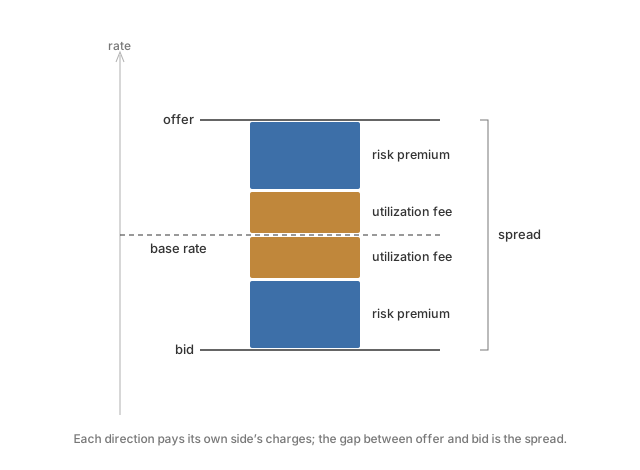
A swap can be opened in either direction. One market lets a trader lock in paying the fixed rate, the other lets a trader lock in receiving it. Both are quoted from the same anchor, the base rate, our best estimate of the average floating rate over the swap's tenor.
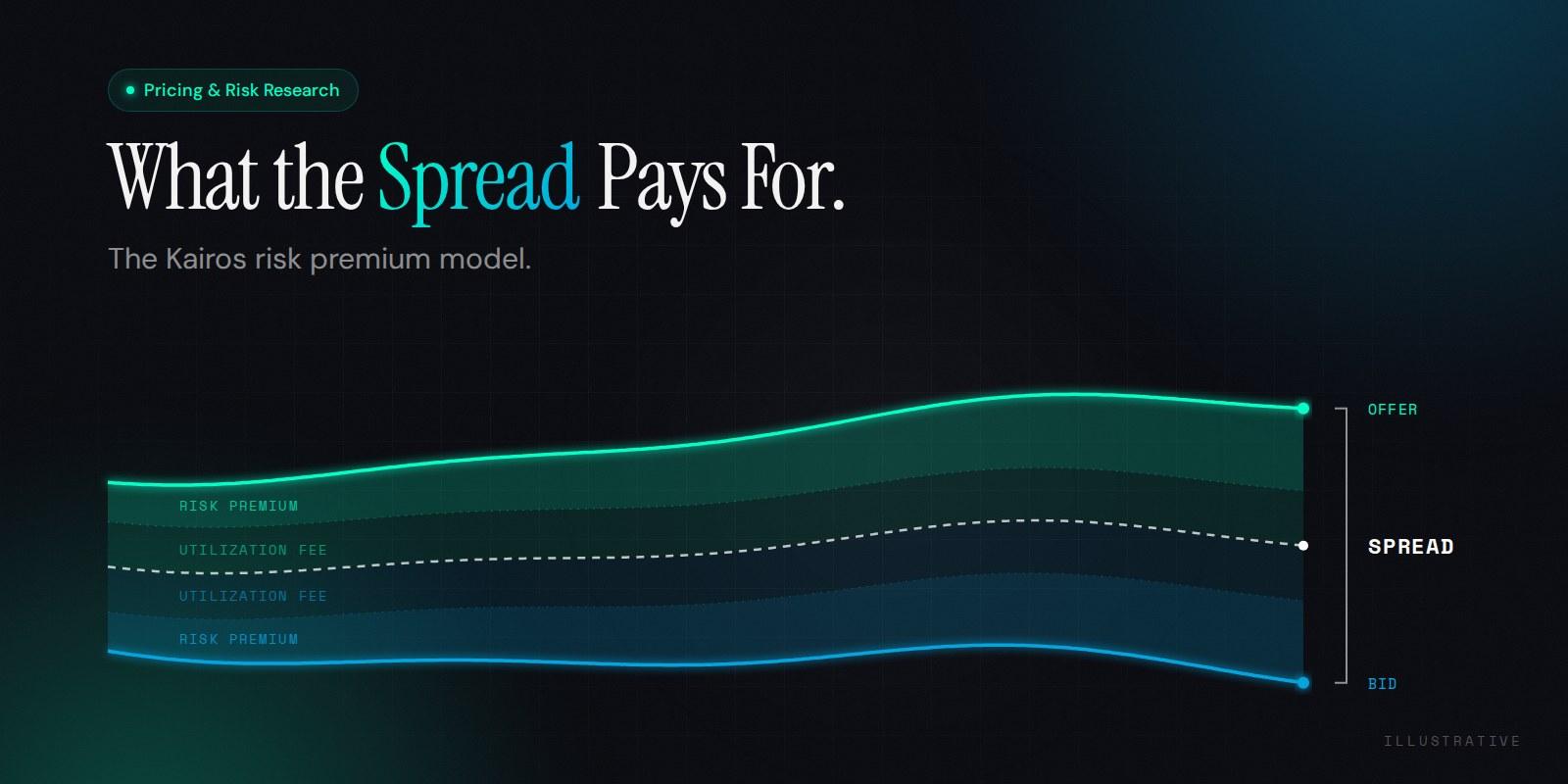
Each direction adds two charges on its own side of the anchor. The utilization fee is a capacity price. Every open swap is backed by the pool's liquidity, so each new position commits part of a finite balance sheet, and the fee rises as less of it remains, the way any scarce capacity should cost more as it fills. The risk premium is the uncertainty charge, priced from how far the average rate over the swap's life can land from that estimate, whether the rate moves on its own, is moved by a changed curve, or is pushed deliberately.
The result is an offer above the anchor and a bid below it, and the gap between them is the spread. Each trader pays their own side's charges to the pool that stands opposite them, and those charges are what LPs are paid. A buyer also collateralizes the swap at purchase, at the full rate they trade at, so a position is funded the moment it opens and the pool takes no counterparty risk on a promise to pay later.
Model the state, then map to the rate
In traditional markets, pricing a vanilla interest rate swap is barely a modelling problem. The fair fixed rate is read off a forward curve calibrated alongside a zero-coupon discount curve, both bootstrapped from instruments that trade all day: overnight deposits, SOFR futures, and liquid par swaps. The curve is the market's own answer. Models like Hull-White, Vasicek, or CIR only enter when someone prices optionality on top, such as a swaption, and even then they are forced to reprice those liquid instruments exactly.
Little of that machinery exists on chain. Fixed-rate venues and yield-tokenization markets are building the first points of a curve, but they trade their own rates at their own maturities, not the rate this swap settles on. No swaptions or caps trade on a lending rate, so there is no volatility surface, and no instrument isolates the floating rate itself. Without instruments that settle on the same rate, replication is impossible, and an arbitrage-free price is unavailable. What remains is underwriting: measure how the rate behaves, charge for the distribution of what it might do, and hold capital against being wrong, as an insurer does. The premium is an actuarial number, not an arbitrage one.
DeFi does hand back one thing bond markets never had. The interest rate model is published code. It maps utilization to a rate deterministically; read the contract and you know exactly what rate any utilization produces, including the bend at the kink. The rate is not the primitive object. It is the image of an observable state under a known function.
So we do not model the rate. We model the state and push it through the map.
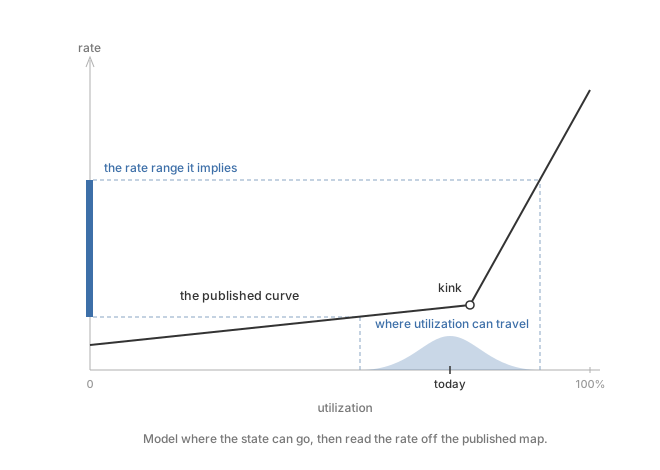
Utilization is a better object to model than a rate. It is bounded: it cannot exceed 100%, so the highest rate the curve can produce is a hard ceiling we compute, not an estimate from a fitted tail. It is mean-reverting by construction, not by assumption: the interest rate model is a controller that makes rates painful whenever utilization strays from target, while a traditional model estimates a reversion speed and hopes the future resembles the fit. And there is no assumed volatility: how widely utilization travels is measured from history, and its translation into rate is written in the curve we read, so there is no parameter to tune.
Calibration then asks one question of history: from a market state like this one, how far has utilization travelled over this tenor? The tails of that distribution set the premium on each side, the offer by how far utilization has risen from here, the bid by how far it has fallen. The history is weighted so a single stress episode counts once, not once per window it touches.
The last step is where the design earns its keep. That dispersion is measured in utilization space and converted to a rate only at quote time, through the live curve. This splits the problem into a stable statistical object, how utilization behaves, and an unstable policy object, the curve, which governance can change tomorrow. When the curve moves, every quote reprices instantly with no recalibration, because the curve never entered the calibration.
A model built on history can only price what has happened before. Where history is thin, the model is built to charge more rather than less, so its failure mode is a quote that is too wide, not too tight.
For this instrument, modelling the state is the right approach. The swap settles on a function of an observable state through a published map, and the model is built around the one thing bond markets never had: the exact map from state to rate.
The map itself moves
Lending protocols adjust their rate curves to keep utilization near its target and lending revenue healthy, and they do it in two ways. Some adjust by decision, a governance process changing the parameters discretely and by hand. Others adjust by rule, the curve updating itself continuously as a deterministic function of where utilization has been. The economic motive is the same; only the mechanism differs. And for an open swap the consequence is the same: the curve it was priced on may not be the curve it settles on.
So the premium carries a charge for it, the expected cost of a curve adjusted mid-swap against each side of the quote, conditioned on the market state and the tenor at entry. The expectation is measured from how often, and by how much, these curves have moved before. The exposure is narrower than it first looks. Because dispersion is measured in utilization and converted through the live curve, a changed curve reprices every new quote instantly. What remains, and what this charge pays for, is the exposure that cannot be avoided, the swaps already open when the curve moves.
Making manipulation unprofitable
The history the model prices from is largely organic flow, borrowers and suppliers acting on their own needs. A swap on the rate adds an incentive that was not there before, a payoff for moving utilization itself, and anyone with enough capital can move it deliberately. A model that prices from the state has to assume that someone, eventually, will try. The attempt can come before a swap opens, to buy a better price, or after it opens, to move what it settles on.
Both attempts run into the same mechanics first. The reference that quotes and settlement read reflects the market over time, not at an instant, so a push moves it only in proportion to the fraction of that time it is held. A push lasting moments, flash loans included, achieves nothing. Moving the reference means holding the push, and holding costs, in carry paid at the higher rate the push created or in yield given up lending at the lower one.
Even a push held long enough to move the reference does not buy a better quote at entry. The offer is not quoted below the fair level the current curve implies, and the bid is not quoted above it. The bounds do not ask why the state moved, and a deliberate push and an organic stress get the same treatment: the premium is quoted from the state, so a strained market is quoted wider as soon as the data shows it, and never at a discount to fair. Those bounds rest on the mean reversion built into the rate mechanism, the expectation that organic flow pulls utilization back toward target and the rate back toward that fair level.
Manipulation after entry is a different problem. The fixed leg is locked the moment the swap opens, so nothing about the entry price protects what happens next. The defense is sizing. The payoff is capped by the size of the Kairos pool, since every position is backed by LP collateral and that collateral at risk is the most an attack can win. The cost is set by the size of the underlying lending market, the capital it takes to hold utilization somewhere it does not want to be. While the largest possible payoff stays below the smallest possible cost, the attack loses money, and that is arithmetic, not policy. If the two sizes ever drift toward profitability, the premium rises as a brake, pricing the payoff back below the cost, and quotes that wide find few buyers, so the pool itself shrinks back toward a size where the attack does not pay.
The payoff-versus-cost comparison is made on the attacker's best case, assuming no other borrower or supplier reacts to the move, so the charge comes out larger than it needs to be. That is the opposite of the assumption behind the entry bounds, deliberately. When quoting, we trust the pull toward target, and a pushed state never improves the price. When costing an attack, we ignore that same pull, and the charge never comes up short. Each calculation takes the assumption that protects the pool, the conservatism a cold start demands, relaxing only as live evidence accumulates.
From model to contract
The premium is recomputed continuously. The model watches the same market data the swap settles on and publishes a fresh value on a regular cadence, and sooner when its inputs have moved enough. A quote reflects the market as it is now.
Each value is posted on chain through an oracle, and the swap contract reads it from there. The contract bounds what it reads. A premium cannot be negative or fall below a floor the contract enforces, and when the posted value is stale, no new swap can open until a fresh one arrives.
Most of what this note describes is enforced by code. The fixed leg is locked the moment a swap opens, settlement follows the reference mechanically, no payoff can exceed the collateral behind it, and both the base rate and the utilization fee are computed on chain from state anyone can read. The risk premium is the one number produced off chain, and it arrives into bounds the contract sets.
That number prices risk. It does not remove it, and no charge could. LP capital bears the outcomes the model measures, and the premium is what makes bearing them worth it. Each market is its own pool, so an LP chooses which risks to bear by choosing where to allocate, whether to take a view on rates or to hedge one. And the design leaves room for markets run on other models and other oracles than ours. The spread is not a promise that losses cannot happen. It is the price of the risk that remains after everything code can enforce has been enforced, and that price is what the spread pays for.